Showing posts with label Thoughts. Show all posts

Saturday, January 10, 2015

OddballGreg - Creative Processes

Well... at least its not a screenshot of Youtube video. 

Creating things, as anyone who has ever tried their hand at one of the many arts, can be difficult. Sometimes artists have no inspiration. Sometimes they hit a "block". The fact is that sometimes things just don't work, and they struggle to find something that they want to do. Lets talk about that.

Creativity and art. These things are essentially synonymous. We unleash our creative urges and create art, even if what we do isn't necessarily art in the normally accepted meaning. (Of course, then we get into the whole debate about what art is or definition of normal, which is a complete article of its own to debate. For now, just accept that when you're creative, no matter what you're doing, you're making art.)

The thing about art, however, is that there is no "right" way to making it. You've probably heard the entire dialogue on it before, most likely in Highschool. 
"Art is an expression of one's own emotions and soul, and signifies their own perspective on the world in a way that only they can achieve." - The voice in my head paraphrasing an old art teacher. (Teehee)

Cliche as my mind's paraphrased words may be, they are correct. Art is unique and relative to the individual and their tastes. There have been many artworks disliked by their creator but adored by others, as well as the reverse. There's no way to measure if something is more artistic than others, so most people will usually understand that perspective is relative and avoid calling art anything other than art when they disagree with it's aesthetic value. (Or they won't... please don't do that.)

Definitions of art... defined, lets actually talk about the reason you're actually reading about this: Creative Processes. As you might have guessed, (or learned first hand), the creative processes behind art tend to be as unique as the art itself. (And by extension, the methods used in making art. Here's looking at you Genitallia artists that use their... well... genitallia to create things. Usually paintings.)

Some people do extensive planning for their artists pursuits. Others... don't. Some, like myself, have a habit of taking a random idea to the apex of a hill and use it like a skateboard to see how far down the hill it takes us. Metaphorically speaking, the latter of the three usually results in a thrilling ride of discovery, but occasionally misses some details. Probably because you only see the subject for a few seconds.

You might think that not planning extensively is simply lazy. Interestingly... no. I've spoken to a fair few dozen of artists over the course of my life, and found that the planning can sometimes be a massive obstacle to the pursuit. If you've ever tried mopping a floor in a kitchen without stepping where you've already mopped, you may be familiar with the sensation of being walled in as you reach a point where you realize you have nowhere to stand in order to complete the final parts of the job. For some, that is the metaphor for their artistic pursuits. Each piece of additional planning only serves to wall them into an enclosed space until they have nowhere left to go. (An experience I am admittedly familiar with.)

On the other side of the spectrum, some people feel unable to work without a guided idea of what they're hoping to achieve. How can they complete the story if they don't know when it ends? How do they know what the characters are like if they don't flesh them out, learn their names and shake their hands. (Mentally of course. If you're shaking imaginary people's physical hands, you should probably dial it back on the drugs.)

Personally, I can work with either method, or a mixture of semi-fleshed out, semi-free-form works when I write or draw, or create in general. (Part of my strangely adaptive personality I suppose.) So why do I usually opt for just grabbing ideas and riding them down a hill? Partially because I'm a tad lazy, especially considering I write blog posts more often than I shave, swim or wear shorts. Then again, partially because it's more fun that way. Most, if not all my blog posts, have had almost nothing more than a random thought or emotion which I wished to convey as I wrote the post, allowing all consecutive ideas and points to flow naturally as I think about it and remember things I've experienced which are related to the topic. If I had to try and plan my posts, you'd probably only get about one a month. (Which is boring for both you and me. So whoopee for wild rides down hills.)

In any case, you've probably gotten irritated at my overuse of parenthesis in this blog post by this point, so I shall leave it off here by simply asking; what is you're preference in creative process as an artist? Do you enjoy winging it like myself, or is planning an absolute necessity. May you even have some specific methodology of your own? Whatever it may be, do be sure to let us know down in the comments below, or via Facebook/Twitter. We here at TCSA love to hear your feedback. And of course, if you enjoy finding out about awesome stuff on the web and world then do please be sure to like the Official TCSA Facebook page and/or follow us on Twitter using the associated buttons on the bar to the left to get all the latest posts as they're published. Also, do be sure to share posts you enjoyed with your friends as it helps us out a great deal. Regardless of what you do, I thank you for having taken the time to read this post; hope that you have/had an absolutely FANTASTIC day, and I will speak again soon.

Keep creating my friends.

Wednesday, October 1, 2014

JovialJman - The Thought Process (Thoughts And Ideas)

"A whole lot of sings on a board are like our thoughts right? or is it just me?" - JovialJman

We as humans tend to link ideas to help us through life. This linking of ideas is part of the creative process to learning, and everything else. Let's talk about that.

The train of thought, is a term people use to illustrate the thought process and the way we think. Often it can be derailed, lost, hijacked and have it revers course. When it is derailed, something has occurred as to make you think about something completely different, and then there is no chance of getting back on track, any time soon. When it is lost, your mind has wandered and just forgotten about the thought, again, hard to get back onto track. Others may have highjack your train of thought by asking you questions and talk about stuff that pertains to you, but this case it is still able to continue onwards afterwards. When your train of thought has reversed its course, you are just going to end up where you started with no real progress.

There is an old myth that you are either right brained or left brained. This is just a myth though, as when thinking about logical things, or being creative you will use both sides of the brains, so unless you have had half of your brain removed, you cannot be left or right brained. This phrase came about when testing on rats. they were able to restrict the communication of one half of the rats brain with the other, then studied them to see how they performed. They saw that those who tried to figure out the maze (analytical) used more of the left side of the brain whereas those that tried to work around it,(creative) use more of the right.

When linking ideas, your brain talks with so many other parts, that there is no sign that one type of thinking is in a specific spot, however, there are cases like speech are more often found to be in the left side of the brain, but that does not mean that everything to do with talking is located there. The brain is a very complicated thing to try and understand.  Everyone's brain is slightly different to everyone else's, which can be seen in the way we perceive things as well as the way we think about them. 

When thinking of items such as names, our brains tend to filter all that it deems irrelevant, which in some cases may actually be what you are looking for. Have you ever tried to recall something, you know it but it just won't come to you? this is your brain trying to help you, but inturn does the opposite. Once you have dropped the subject, your mind no longer blocks the answer and your subconscious may pull it through to your conscious thoughts, that is why you often get the things you were looking for after the subject has changed.

Some of the best ideas people have gotten have come to them when they were in the shower/bath. this is because of the break that your mind needs, like mentioned earlier, and partly because of their dopamine levels. the dopamine in your body allows creativity to flow a bit more easily. this because of the way it reacts in the brain and around the body. When taking a hot shower it is indicated to rise those levels of dopamine, which in turn allows the creative juices to flow.

Anyways, have you enjoyed this little rambling of mine, or do you have somethings you would like to contribute, please let us know down in the comments, on Facebook or over on Twitter, as us here at TSCA love to hear from each and everyone of you. Are there any people you know who likes to know a lot or would find stuff like this interesting, please share it with them as I am sure they will appreciate it. If you would like to see new posts as the are published, or would just like to show us your support, please follow us on Facebook and like us on Twitter, (... wait ... reverse that), using the associated buttons on the bar to the left. I hope you have/had an epic day, and I shall write again overmorrow.

Happy thinking buddies.

Thursday, August 14, 2014

Thoughtful Thursday - Perceptions (Did you not see what you saw?)

Hello and welcome to Thoughtful Thursday; the day of the week where I tell you about how your brain lies to you, or do I?

Image was taken from http://eyetricks.com/0101.htm. Wondering what the new logo at the top of the image is about? Make sure to read Saturday and Sundays posts to find out.

Have you ever seen something that wasn't there? Provided you weren't on any type of hallucinogen at the time, you were probably a victim of your brains incorrect perceptions. Yes. Brains can be wrong too, and they can be so in a multitude of ways for a variety of reasons. Let's talk about that.

If you have ever seen strange faces in bricks or thought that a tree was staring at you, your brain has essentially deceived itself due to the simple fact that it likes facts, rather than malleable concepts. A study of psychology known as Group Psychology is centered around the fact that your brain does not percieve the pieces of what you sense, but what you sense as a whole. You don't smell the individual spices in a stew, you smell a stew. (Or, in the famous case that led to the discovery of Group Psychology, 2 slides of a vertical line and a horizontal line changed at a high enough speed, will be perceived as the line rotating.) It should be noted, I may be wrong about the name of this brand of psychology.

My ever favourite science and fact channel on YouTube, Vsauce, frequently talks about interesting facts concerning perceptions all the time. For example, this video discusses the way that the brain can perceive occurrences incorrectly and make you believe that it just happened, thus leading to Deja Vu. Another video explains how, even at this very second, your computer, phone, or tablet screen is lying to your brain right now. The yellow you're seeing all over my blog right now, (That is, if you're reading this when the blog is still yellow.), is little more than your brain assuming that the light coming off of your screen is actually yellow.
Yet another video is devoted to illusions, and discusses everything from the brains natural wish to assert itself as controlling over it's situation and future, to the fact that your brain is rather stubborn, and will often refuse to admit that it's wrong; choosing to rather change your perceptions in accordance with what it thinks is happening.

The point of the fact is, your brain, is easy to lie to, and easy to confuse, simply because of the way it works. While you can consciously understand concepts and decide that you were previously incorrect due to the grouped effectiveness of your mind, your brain is very much just an electrical machine with a massive tangle of cables. The electricity only flows one way and if one of the cables stops working properly for some reason, the rest of the machine for better or worse, continues to function to the best of it's ability. It has no ability to reconsider previous assessments.

This is not entirely a bad thing, as the constant stream of data which your brain sifts through in near real-time ensures that you can function and react effectively at all times. What would happen if your eyes decided they wanted to review what they said earlier while you were driving? (I can't see the result being altogether pleasant.) However, the downside to this is that incorrect assessments are never corrected, which is part of what leads to Phobias.

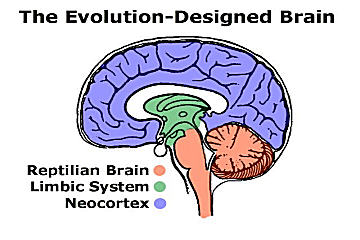
Phobias are the brains excessive and irrational fear of all things related to a certain subject, often as result of a traumatic incident involving that subject... or not. Phobias are caused by what is perhaps colloquially known as the "reptillian brain" which is the basic brain stem and the effective center of your brain. This part of your brain is most typically responsible for the preservation of your life, and handles things such as breathing, metabolism to a degree and, important to this discussion, the flight, fight or freeze responses.

Image is from http://www.wisdompage.com/FlawsInMentality.html
The thing about the conscious mind is that it is somewhat slow. You have to think about things, and then make decisions about them. And even woman can't multitask all that much, if the stereotype is to be believed. So your senses are processed first by the reptilian brain before your main cortex which is responsible for sapient thought. This allows you to react without thinking and is pretty handy for rolling out of the way when a bear is about to give you a hug. (Or some other reasonably fatal situation needs to be escaped.)

The problem arises however, with how your reptilian brain decides what is something that needs to be reacted to. Patterns. As a child, the first time you saw fire, you probably wanted to play with it. This is because your reptilian brain did not yet know what kind of danger the fire could pose to you. Once you harmed yourself however, the reptilian brain understood that fire = pain and hurt, and thus any time you encountered fire from then on, you were probably far more weary even before you had consciously decided to be so. This is good. It keeps you alive. The problem comes in with trauma, either physical or emotional. It's widely believed that the cause of Phobias is a result of patterns related to a specific, traumatic incident, not leaving the reptilian brain once the need for quick reactions is over. This leads to continual terror as the brain continues to think it is in danger and looks for a way to preserve itself. 

Perhaps even worse, is that in the same way that thoughts and memories are linked through neural synapses, your reptilian brain begins to associate non-dangerous things to the Phobia in this state. So you can go from merely being afraid of spiders, to being scared of TV's because a picture of a spider on the TV triggered a terror attack. The next time you see a TV can make you scared of where you saw that TV... and so on and so forth. Brains are rather stupid sometimes.

So why is it then, that sometimes, we seem to see or feel things that aren't actually there? Or perhaps the hairs on the back of your neck stand on end, and you can feel someone's eyes on you? Well, to explain that, you need to understand that the human brain's first and foremost goal is self preservation. Anything it can do to give itself an edge in life, it does to the best of it's ability.

I mentioned earlier about how you might have seen a face on some bricks. (or toast.) This is one of the brains methods of self-preservation. Friend or foe, most creatures have a face. So it pays to notice them when you see them. In a similar situation, you will find that in classrooms or public places, it's fairly typical for you to notice when someone is watching you. This is again to help you know when you've attracted (un)wanted attention.

Interesting enough. Humans are the only creature with white eyes. At some point in our evolution, we decided that we no longer needed the camouflage of less seen eyes, instead favouring the social aspect of white eyes which helps people to know when you're looking at them.
In the end, those playing the game of survival of the fittest, and those with all the best weapons and advantages, move on to reproduce. So the next time time you think someone is watching you, listen to that "gut feeling". It might be more correct than you think, and all in thanks to your ancestors who used that sense to survive long enough to extend your bloodline down to you. If you found this article interesting, or would like to mention something I got wrong or missed out, be sure to let me know in the comments below or over Facebook and Twitter. Also, be sure to share this with any friends you think might find it interesting as well. Of course, if you would like to read more articles like this, be sure to follow me on Twitter and/or like my Facebook page so that you can get the latest articles, as I post them. Regardless of what you do, I thank you for taking the time to read this article; hope that you have/had an absolutely fantastic day, and I will speak again tomorrow.

Stay frosty friends.


Related Posts Plugin for WordPress, Blogger...